- And once again, the right message made the difference
- The threshold problem (and why it traps your best leads)
- I have been watching this pattern for four years
- The Warm Activation Sequence: a four-step pattern
- This is not spam — and here is the line that separates the two
- Content and outbound are not opposites — they compound
- How to start tomorrow
I am getting more inbound LinkedIn leads right now than at any point in my career — and the outbound messages I still send every week close more deals than the inbound ones do. Not because the inbound is bad. Because most of my best leads were never going to write first.
And once again, the right message made the difference
Three weeks ago, someone accepted my connection request. I had not heard a word from him since. No reply to anything, no comment on a post, no DM. From the outside, a flat connection.
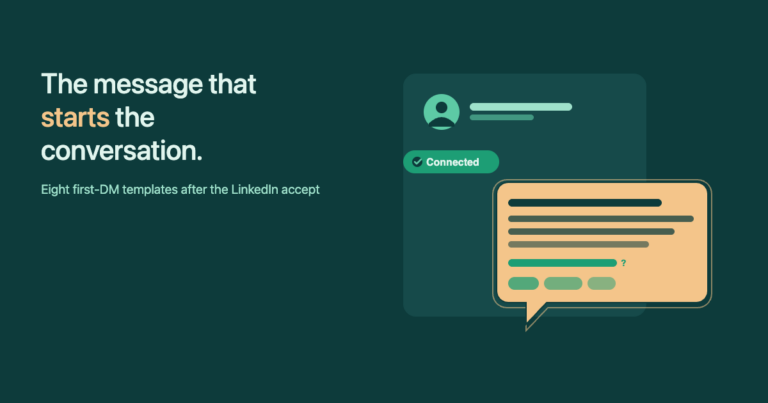
I sent him one message. The same low-stakes opener I use for every new connection once they have had a couple of weeks to see what I post: „Hey, glad we are connected — is the topic I post about generally relevant for what you are working on?“
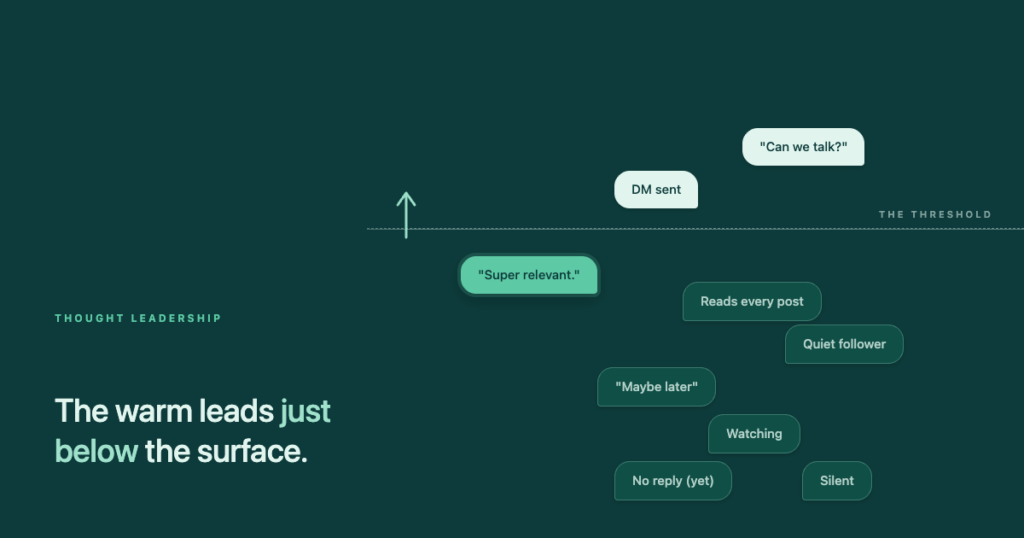
His reply: „Super relevant. I have actually been following your content very closely since we connected — this is exactly what I am dealing with right now.“ A meeting was on the calendar by the end of the day.
Read that again. He had been following my content „very closely“ for three weeks. He knew what I do. He found it directly relevant. And he never would have written first. The DM was not the start of the relationship — it was the permission slip for him to admit the relationship already existed.
The threshold problem (and why it traps your best leads)
A threshold lead is a person who is interested enough in what you do to follow, read, and silently agree — but not interested enough to take the first action themselves. They sit just under the line between passive consumption and active reach-out, and they almost never cross it on their own.
Threshold leads are not cold. Cold leads do not know you exist. Threshold leads know you, they have formed a positive impression, and if you asked them directly they would say your topic matters to them. They are also not inbound. Inbound leads did the work of reaching out. Threshold leads are a third category, and they are usually the largest one — and the most ignored.
Why do they stay silent? A few overlapping reasons:
- Initiation has a real cognitive cost. „What do I even write?“ is enough friction to defer the message indefinitely.
- They fear a pitch ambush. If they DM you, they assume you will pitch them. Easier to keep observing.
- „Maybe later“ is the default. They are not blocked from talking to you, they are just not blocked from anything else either — there is no forcing function on their side.
- The asymmetry of social effort. Replying to a message is near-zero cost. Initiating one is expensive. Most people will pay the small cost; almost no one volunteers the larger one.
This is not about LinkedIn specifically — it is just how warm-to-buyer transitions work for almost any service business. The platform that surfaces it most clearly is LinkedIn, because the followers, the post views, and the connection-acceptance rates are all visible to you. You can literally count the threshold leads in your network. Most of them you will never hear from unless you write first.
| Lead state | What triggers action | Typical timeline to a call |
|---|---|---|
| Cold | Nothing exists yet — they need to be introduced to you, to the problem, and to the solution all at once. | Weeks to months, low hit rate |
| Threshold (warm) | One low-stakes message from you that gives them permission to engage without committing. | Hours to days, high hit rate |
| Inbound | An internal event (deadline, frustration, new role) crosses their own decision threshold without your help. | Months to years (or never) |
I have been watching this pattern for four years
The first time I noticed this on LinkedIn was in my first few weeks on the platform, roughly four years ago. I had no content, no following, no inbound. I had a list, a profile, and a few hundred connection requests I was going to send manually.
One of those early DMs went to a person who, today, is one of my longest-running clients. The account has compounded across years and is now nearly a six-figure revenue line. Everything I have ever earned from that relationship traces back to a single message I sent in week three, to a stranger, with almost zero social proof on my profile.
The point is not that cold DMs are magic. The point is that the same dynamic that worked then still works now, just with the temperature dial turned up. Four years ago I had to do the warming inside the message itself. Today my content does most of the warming before I write anything. But the DM is still the moment the relationship actually starts.
I have generated multiple six figures of revenue this way, and I have watched clients I advise do the same. The mistake almost everyone makes is treating „I am posting content“ as the strategy. Posting content lowers the friction. It does not push anyone over the threshold. Only a direct, specific message does that.
InFilly auto-fills {first}, {company} and {title} into your LinkedIn message templates with one click. The DM stays personal — you just stop retyping the same setup line for every contact. No automation, no account warnings.
The Warm Activation Sequence: a four-step pattern
The pattern that has worked for me — and that produced the meeting I described at the top of this article — has four steps. None of them are clever. The sequencing is the whole game.
Step 1: Connect — and put no pitch in the request
The connection request itself is not the activation point. It is just the door opening. If you put a pitch in the request, you have already lost — they will accept or not based on whether your profile is interesting, and a sales line in the note works directly against you. Either send a blank request or write one sentence that is purely about why you want to be in touch. No call to action.
Step 2: Wait one to two weeks — let your content do the warming
This is the step most people skip, and it is also the one that makes the activation message land. Once a person is connected to you, your posts start showing up in their feed. If you are posting consistently — even two or three times a week — they will have seen a couple of pieces of your work before you ever DM them. That is the difference between a cold message and a warm one. By the time you reach out, you are not introducing yourself. You are following up on something they already know.
The obvious caveat: this only works if you are actually posting content. If your feed is empty, the one-to-two-week wait is just silence and you may as well message immediately. But the moment you start posting anything regularly, this step becomes the highest-leverage thing you can do — because it shifts the activation message from „stranger asking for time“ to „person whose ideas I have been seeing for two weeks.“
Step 3: Send the activation message — low stakes, one question
The whole point of the activation message is to give the other person permission to engage at the cost of one short reply. That means: no pitch, no calendar link, no asking for their time. Just one question they can answer in a sentence — and the question should be about whether the topic you focus on is relevant to them right now.
This is the exact template I use:
Hey {first}, glad we are connected.

You probably saw I post a lot about {topic}. Curious — is that something you are dealing with at {company} right now, or more of a future thing?
Notice what is not in there. No „I would love to jump on a quick call.“ No „happy to share more about what we do.“ No introduction of my product or service. The question is binary, easy to answer, and entirely about them. That is what makes it land.
Step 4: Respond to what they actually said
If they answer „yes, relevant“ — anything in that direction — you do not pitch. You ask one follow-up question to understand which specific version of the problem they have. The meeting offer comes naturally after that, and very often it comes from them. If they answer „not really“ or „future thing,“ you thank them and move on. They are now in a different bucket; do not waste the goodwill by pushing.
The win condition here is not booking a call. It is getting an honest answer about whether this person is a threshold lead or not. The ones who say „yes, relevant“ book themselves on your calendar within days. The ones who say „not for me“ save you the ten future messages you would otherwise have wasted on them.
This is not spam — and here is the line that separates the two
Anything that scales without judgement turns into spam eventually. The activation sequence works because every part of it is built to respect the recipient. The same pattern, automated and decoupled from any individual context, would be exactly the kind of thing that gets people to mute LinkedIn entirely. The guardrails matter.
- The question must be about them, not you. The moment your activation message contains the words „we“ or „our,“ you have crossed a line.
- One follow-up, then nothing. If they do not answer the activation message, send one polite „no pressure if not relevant“ message a week later, and then you are done. Pretending you did not notice the silence is the worst version of yourself.
- Their „no“ is final. If they say the topic is not relevant, that is the last activation message they get from you, forever. They can still see your content; they have just opted out of direct outreach.
- The friend-justification test. If you could not explain why you sent this specific message to this specific person to a friend, do not send it. If your justification is „they were on the list,“ you are doing the wrong thing.
Content and outbound are not opposites — they compound
The default LinkedIn advice you will read on most days is some version of: „just post valuable content, and the right people will come to you.“ This is partly true and mostly wrong. It is true that content makes outbound work better — it warms people up, builds trust, and turns the activation message from cold to warm. It is wrong in implying that content alone is a strategy.
Content lowers the cost of being reached out to. Outbound monetises that lowering. Without outbound, you are waiting for threshold leads to spontaneously decide that today is the day they message a stranger about a real business problem. Most of them never will. Their problem will get solved by whoever DMs them first. That can be you, or it can be the next person.
An inbound-only strategy is a multi-year compounding play. It works, eventually, if you are consistent. But the activation sequence collapses that timeline. The same person who would have come to you in eighteen months — if they came at all — comes to you in eighteen hours when you ask the right question at the right time.
How to start tomorrow
If you want to try this without overthinking it:
- Pull the list. Open your LinkedIn connections and filter to the people who accepted your request in the last 30 days and have never exchanged a message with you.
- Pick ten. Of those, pick ten who fit your ICP — the kind of person you would actually want as a client.
- Send the activation message. Use the template above. Customise
{topic}per person if their role suggests a different angle, but keep the rest stable so you can compare what works. - Wait 48 hours. Reply to the people who answered. Note the ones who said „yes, relevant“ — that is your real warm pipeline. The ones who said „not for me“ go on a do-not-message list, with respect.
- Repeat next week. Same filter, ten more people. This is a recurring routine, not a one-off campaign.
After a few weeks of this, two things will be obvious. First, your hit rate will be far higher than any cold outbound you have ever done — because every person you message is already warm. Second, you will start to see how many of your booked calls trace back to a single activation message that the prospect would never have sent themselves. That is the threshold problem, solved.